





The former Wales full-back has announced his retirement from all rugby after struggling with a knee injury
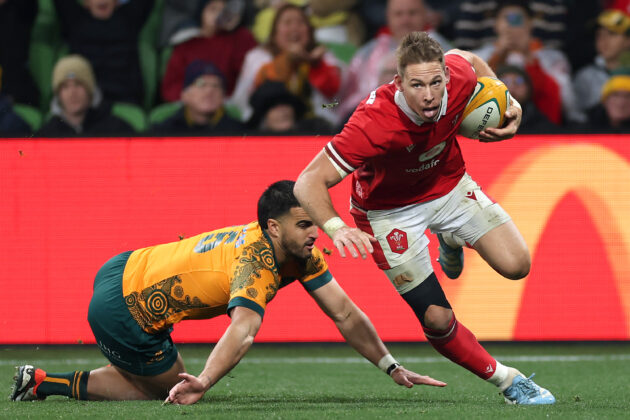
March 2026 saw Liam Williams retire from all rugby at the age of 34, thus ending one of the most successful, and varied, careers in the history of Welsh rugby. At 6ft 2 inches tall and just 13 stone 5lbs (85), many observers of his early career thought he was too wiry to make it to the very top.
But let’s not forget that there are many different types of wire. On the wire spectrum, Liam Williams falls somewhere between barbed and razor.
Read more: Neutral venues could be used for Gallagher PREM play-offs
Grateful for every memory, and a thank you to everyone who backed me along the way.
A special journey, but time to hang up the boots. On to the next chapter ❤️🏉 pic.twitter.com/SlwWgBbXtR
— Liam Williams (@SanjayWills) March 25, 2026
Despite having a thoroughly modern professional rugby career that saw him play across the globe, there was always a touch of the old school about Liam. He didn’t go straight into a rugby academy, and then a pro career, like many of his generation.
So, he became an apprentice scaffolder at the steelworks in Port Talbot – which is probably where his love of operating up in the air came from. Whilst working there he played for Waunarlwydd RFC, a club on the outskirts of Swansea and just two miles from my rugby club – Gowerton RFC.
But there’s only so long that a player like that can go under the radar and he was grabbed from the Mason’s Arms and drafted into the Scarlets/ Llanelli system. In the Llanelli system, at the age of 19/20, he became an almost instant success where his playing style once again fused the old school with the new school. I
In 2011-ish world rugby was dominated by ‘kick tennis’ – especially at Test level. Many teams were terrified of turning over the ball in the middle third, due to a new 2009 law interpretation where the ‘jackaler’ didn’t have to release the ball after the tackle, but the ball carrier did.
It led to a generation of kick-focused full-backs and wings whose primary role was to dominate the air/ defend – and very little else. But Liam was different, he was both exceptional in the air and when he got back on the ground. He was to become part of the northern hemisphere’s new generation of counter-attacking fullbacks.
His running style was unique. Genuinely unique, due to the shape of his legs. I have never written about his legs before, partly because it seems rude and partly if he takes it as being rude, I don’t want to get on the wrong side of him should I see him in my village…
But he has openly spoken about his legs and how they gave him a unique running style. For those who haven’t seen him up close, his legs are what he has described as bandy, they arc inwards. As a child he was offered the chance to have them corrected medically – by snapping them in two places on both legs. But he chose not to due to the risk that he would never be able to play rugby again should the operation go wrong.
So instead of choosing to have his own legs snapped, he chose to keep them as they were and snap the ankles of defenders instead.
You cannot talk about his style of rugby without mentioning his levels of aggression. Early in his career he was often described as having a short fuse, which is inaccurate – he didn’t have a fuse at all. The detonator was linked directly to the bomb – and on occasions it would get him in trouble. But when you combine that level of aggression, speed, wiry frame and unusually angled legs it was like tackling/being tackled by a sack of chisels attached to a Ducati Panigale V4 R.
Liam Williams 🔛🔥 pic.twitter.com/lcDe0A3WJy
— British & Irish Lions (@lionsofficial) December 19, 2025
Despite Liam’s relatively old school entry in pro rugby, his achievements were thoroughly new school. At club level he was part of the Scarlets team of the mid-late 2010s who not only won the Pro 12 title in 2017, but were also playing some of the most attractive rugby on the planet.
From there he moved to Saracens, who at the time were the ‘big budget’ version of Saracens – who only signed the very best. There, he not only lifted the supporters off their feet but also raised some serious English and European silverware – he won both the Premiership and Champions Cup.
From there he went back to the Scarlets, then had brief spells at Cardiff, Kubota Spears and Saracens – before finally ending up signing for Newcastle Red Bulls. But whilst Red Bull can give you wings, sadly it can’t give you new legs – and it unfortunately brought his career to an end.
Injuries took their toll in the final years of his club career, but he will always be known for his fully fit, fully functioning, full-fat rugby at the Scarlets and Saracens.
The old school/new school style of Williams’ career was never more evident than at Test level, where he almost became a genetic clone of JPR Williams. He played 93 times for Wales, and with each cap gave everything he had.
To see him defending the corner flag was truly incredible – it was like watching the opposition’s ball carrier running into a 13-stone combine harvester. He scored 21 tries in total for Wales and won two Six Nations Championships – one of which was a Grand Slam.
But arguably Williams’s greatest achievements came with the British and Irish Lions. He toured with the Lions to New Zealand in 2017 and South Africa four years later – playing in five Tests across the two tours. On the tour of 2017, he became a truly global name.
The Kiwis are a difficult rugby audience to impress, for obvious reasons, but impress them he did. During that tour in 2017, I was getting about three or four requests a day from New Zealand media wanting me to speak specifically about Williams and his impact on the tour.
Liam Williams has had an incredible career. From putting up scaffolding for someone else, to building his very own rugby legacy. Well played, Liam. It was a joy to watch you play.
Download the digital edition of Rugby World straight to your tablet or subscribe to the print edition to get the magazine delivered to your door.