





Rugby World went to HMP ISIS to meet 3Pillars, a charity using rugby to help rehabilitate young offenders in England…
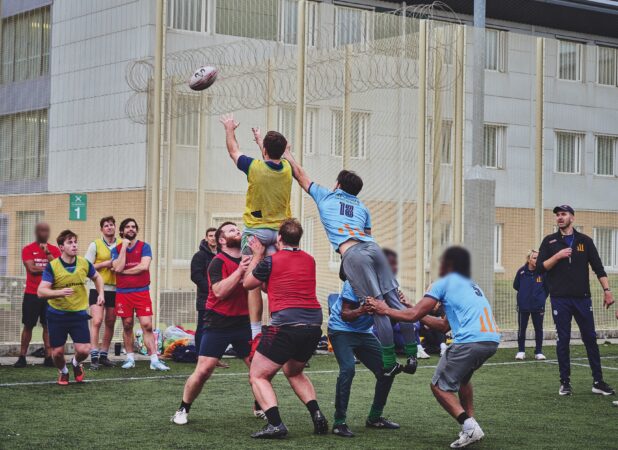
“I’m glad we can have a good news story about prisons for once.” That’s the first thing I hear when walking into HMP Isis, a Category C men’s prison and young offenders’ institution (YOI) in South-East London. The narrative, particularly recently, around the prison system in England and Wales is often one of violence and overcrowding.
Long periods of austerity in the UK led to sweeping budget freezes and cuts to most public services. Prisons were hit hard as, unlike education and health, spending on the custodial system is not a natural vote winner. The UK Government spent less on prisons each year between 2011 and 2020 than it did in 2010, despite the average cost per prisoner rising during this time. It also coincided with a steep increase in people being put behind bars, which caused overcrowding in many institutions.
Read more: Six Nations fixtures
The prison population of England and Wales has doubled over the past 30 years, currently sitting over 87,000. This has contributed to a rise in prison violence throughout the 2010s too, both self-harm and prisoner-on-prisoner incidents, with a peak of 371 deaths in custody recorded in 2021 and 33,000 assault incidents in 2018. Meanwhile, statistics show that 26.5% of prisoners in England and Wales will go on to reoffend within one year of being released, a figure that rises among young offenders.
Ultimately, prisoners are in prison for a reason: they committed a crime and are therefore rightfully serving their punishment for it. So what has rugby got to do with all this, I hear you ask?
Why is rugby being played in prisons?
“Mike Crofts is our CEO and he was a former captain in the British Army who did two tours of Afghanistan,” explains Joe Maksymiw, a former professional rugby player who is now Partnerships and Impact Lead at criminal justice charity 3Pillars Project.
“He came back and did some volunteering at HMP Feltham, which is also a young offenders’ prison and has the highest rate of violence of any institution in the UK.
“He was surprised by the sport provided to people and always talked about seeing the same kind of people in prison as he would see in the army. He wanted to give them the behaviours of discipline, integrity, communication, teamwork and resilience, pillars that he had experienced in the army, to help drive them forward in life.”
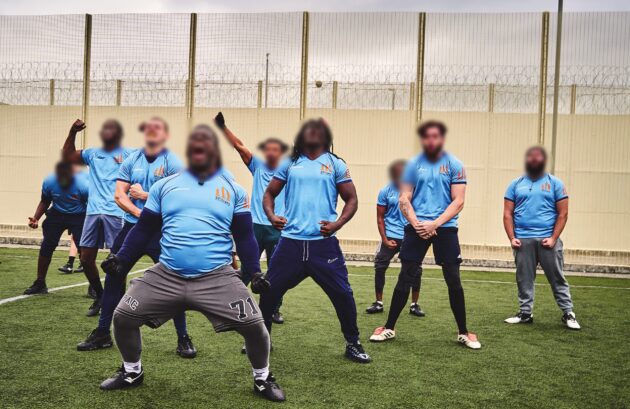
Prisoners in the Three Pillars Charity’s Rugby Prison Program In HMP ISIS (Phil Barker)
Maksymiw points out that 74% of inmates in YOIs have had four or more Adverse Childhood Experiences, such as abuse, neglect or household dysfunction, compared with just 9% in the general population. And with only 10% of prisoners in England and Wales serving life sentences, it means 90% will at some point be released back into society.
“We understand that these men have committed crimes and we are not trying to change their sentences,” he says. “But we are also working in Cat-B/C/D prisons, with men who one day want to be released back into society. And we’re ultimately not a charity giving sport to prisoners. Mike sees sport being a Trojan horse. Building trust with young men through sport and using that trust to develop mentoring and working towards post-release life.
“We are helping these men to integrate back into society, change their perceptions, to be trauma-informed and then help them through lasting behavioural change. If as a society we’ve decided to lock these people up but not forever, what is our plan for when they are released? If that’s the decision we’ve made, you have to have a plan.”
Read more: How to watch the ongoing Champions Cup
And the grand plan of 3Pillars is to focus on changing the key behaviours of these young men in order to reduce the likelihood of reoffending by providing them with behaviour changes through rugby. A sport that all you readers will agree can be the perfect vehicle for providing discipline, integrity, communication, teamwork and resilience. This is delivered through the Gameplan programme.
How is this helping rehabilitate young offenders?
Starting with an eight-week course of five hours per day, twenty prisoners will enroll in the Rugby Academy, which has a two-prong approach. Firstly, learning the skills of rugby on the pitch in the morning, everything from passing to scrummaging to lineouts, with the goal of sessions being inmate-led by week eight.
Alongside that will be workshop-based learning and coaching in the afternoons centred around those pillars and learning new behaviours for change that empower and encourage responsibility and leadership. Participants will then be able to earn a Sports Leaders qualification and progress to the Fit For Future Academy, which specialises in resettlement and reintegration into society post-release.
It’s about arming these men with skills that can be utilised for good in society and unlearning the skills and traits that saw them incarcerated. But I know what you are thinking. Rugby is intrinsically a physical and aggressive sport, so does that not present an issue within the prison? It is actually the opposite, it provides an opportunity.
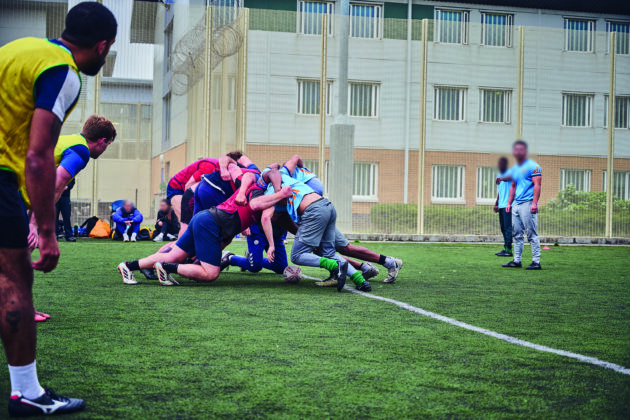
A maul is formed during the match (Phil Barker)
“We pick rugby for two reasons,” Maksymiw continues. “Reason one is because not many people in prison have played before. In this pilot course at HMP Isis, only two participants out of 20 had played previously. That enables group growth. If you went in with football, there would be a hierarchy.
“Rugby gives us a level playing field where we can achieve group growth and encourage being comfortable with learning.
“And number two, sure, rugby is an aggressive sport but it is disciplined aggression. Rugby is a powerful way of showing how aggression can be used in a controlled and disciplined manner. In the workshops we run alongside the sport side of the course, we will talk about the chimp paradox, the body’s natural fight or flight instinct.
“After a few of the weeks, we talk about reacting to being smashed on the pitch. This allows us to show them how they can control themselves in real life if they can show us they can control themselves on the pitch, transforming that development into wider life.”
Read more: How to watch Champions Cup
The use of a new skill is crucial in all this. Rugby is alien to most inmates, which means all those taking part have to work together. It creates a situation where showing vulnerability is encouraged, something that is at odds with the bravado that prisoners so often feel they have to assume while inside, especially when you consider that more than half of all inmates in Isis have a gang affiliation, with around 136 active gangs in the prison. Providing a space where they can escape that is vital.
What was it like playing rugby in a prison?
When Rugby World attended HMP Isis, it was on week eight of the pilot programme and alongside another 15 or so volunteers, all of whom played rugby in the local area. We were there, effectively, to give the participants a full-contact game. To show the inmates what the sport they had been fast-tracked into was about in reality but also to showcase their behavioural development through the course.
Amandeep Gill, an Operational Support Grade and local rugby player who initially convinced Governor Emily Thomas to introduce rugby into the prison, explains how stark the change has been since week one. “We started with a taster session to see if there would be any engagement because there was no point if no one was going to turn up. I went around to all the prisoners individually to get sign-ups and ended up having 120 names,” says Gill.
“A priority for me was making it fair. There are some boys on this course with enhanced incentives and privileges, some with basic.
“I wanted to take boys from both to give them a chance to prove themselves and for us to show a little belief in them. It pushes you to go the extra mile.
“From session one, you know what, there is such a noticeable difference in their attitude. They lift each other up, they will pull each other up if someone’s not listening. Challenging behaviour in a positive way. You can see it actually bringing the participants together.”
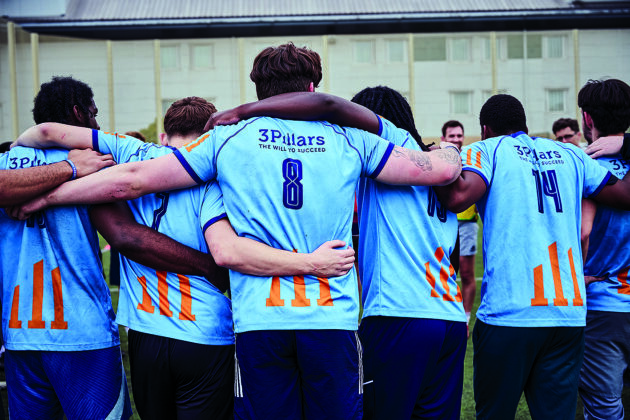
Players arm-in-arm as part of the 3Pillars programme (Phil Barker)
Maksymiw adds: “The first reason they sign up is to get out of the cell. Over half of prisoners spend the majority of a day locked in their cells. They say they were bored, something to do, but that’s our way in.
“That’s why week one and two are much more about rugby than the learning side of things. It’s about getting them out of the cells, enjoying themselves and building trust with us.
“We introduce contact slowly. We have more behavioural issues as we haven’t built any trust yet. They get told what to do constantly in prison and I’m coming along and doing the same. We get a lot more resistance. As the trust builds, the resistance disappears. It shows that you can develop that trust quite quickly.
“We build rugby in very slowly. Week one and two is mainly passing and passing backwards. Then we introduce the classroom qualification side of things as we continue.”
Read more: What is a maul?
By week eight, the difference is staggering. Before starting the full-contact game, the inmates led the volunteers in a series of warm-up exercises and rugby-related drills. Despite all 20 of the prisoners on the course being under the age of 25, they led a group of strangers through various games and exercises, explaining the rules, holding one another to account when it came to keeping score or providing an honest call on incidents that the referee was not able to see.
When it came to more technical elements such as the lineout drills or scrummaging, many of the young men were actively asking questions about technique, showing a willingness to keep learning. Throughout the day, the only person who found themselves told off by staff was Rugby World photographer Phil for standing in the wrong spot.
Prior to playing the final game, all volunteers were asked to sign the 3Pillars contract. A pledge to uphold the five behaviours picked by prisoners on week one.
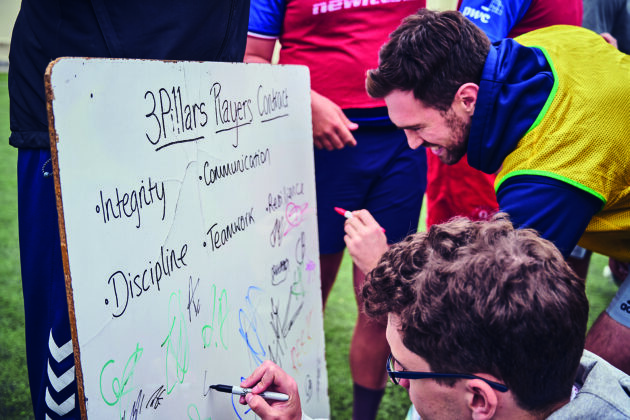
Players write down principles (Phil Barker)
The game itself was fascinating. Of the 15 volunteers who had come in for the final week of the programme, a handful were old friends from Maksymiw’s playing days and were still running out at National League level. It meant that after 30 seconds of pretending to take it easy, big shots and hard running lines began to fly in from the volunteers and were met with the exact same intensity from the inmates. And despite some monstrous hits from both sides, it was played with the same respect evident in any rugby game.
At the end, we all shook hands and if anything, the prisoners seemed overwhelmed by the fact we had taken them seriously on the pitch. One participant told us: “I’ve never played rugby before, so this is all new to me. In prison you don’t really get stuff like this. So being able to come out here and learn a new skill, but also learn things that I can hopefully use in real life once I’ve been released, is really helpful.
“It was good to see what a proper rugby game was like too. You guys weren’t holding back but it shows you treated us with respect, so we could only return that. I would consider continuing with rugby after I’ve been released because it has taught me so much.”
How can participants learn through rugby?
Participants learning a new sport is merely a byproduct of this programme. The real impact is the lasting changes. “Things like this make a huge difference,” Gill tells us. “On the rehabilitation side of things, the 3Pillars Project provides a post-custody officer who comes in and talks to the boys about life after prison. They discuss steps for bettering themselves, how they can move forward with their life and learn new skills and be a better person. Inmates may also be looking to move to a D-Cat prison, which is semi-open, or want to be up for parole or even get early release – and this programme can help with that.”
Maksymiw adds: “By week eight, we want to look at hope, opportunity and community, and whether we are leaving them with that. The experience of enjoying something new, having hope for the future and building that community within the prison.
“The next step is then about building long-term pre-and post-release support for inmates. We continue with participants after the course to specialise in mentoring. Depending on the men, it will be tailored to their needs. Some may need closer help like CV-writing support or looking for jobs and even giving people their first experience of being in a job.”
Read more: What is a 50:22?
Most of these young men will be reintegrated into life on the outside. The hope is that they not only fail to reoffend but become valuable members of society. For that, they ultimately need hope. The 3Pillars Project can provide these young men with that hope through the form of rugby. It can change these men for the better when they are back in society – and that feels like something we should all hope for.
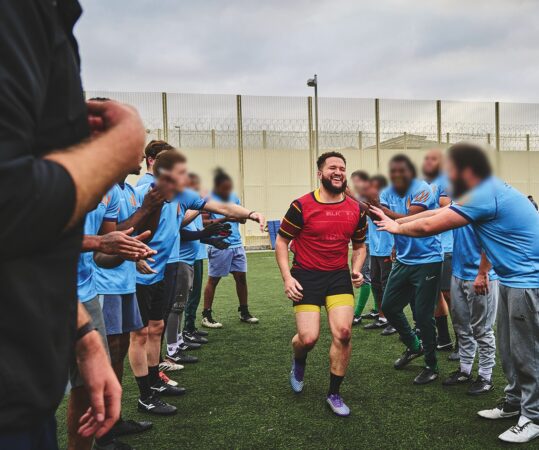
A guard of honour post-match (Phil Barker)
How one participant went the extra mile
Participant Ben Ellet took part in the 3Pillars programme at HMP Dovergate in 2023. Following the course, he was given a copy of John McAvoy’s book Redemption, the story of a reformed career criminal who transformed into a world record-holding endurance athlete.
Inspired by the tale of McAvoy and realising his own self-worth, Ellet decided to set ambitious fitness goals while in prison, all with the aim of proving himself as capable. While in custody, Ellet decided to attempt a massive challenge – to set the British record for 100,000 metres on a SkiErg.
Defying physical and mental pain for hours on end, he achieved the incredible and broke the record with a time of 7hr 1min. Ellet credits the 3Pillars course and his learnings from McAvoy for being critical in his complete mindset shift and breaking the record.
Download the digital edition of Rugby World straight to your tablet or subscribe to the print edition to get the magazine delivered to your door.