




Argentina starlet Juan Martín Hernández was a player who made rugby look easy…
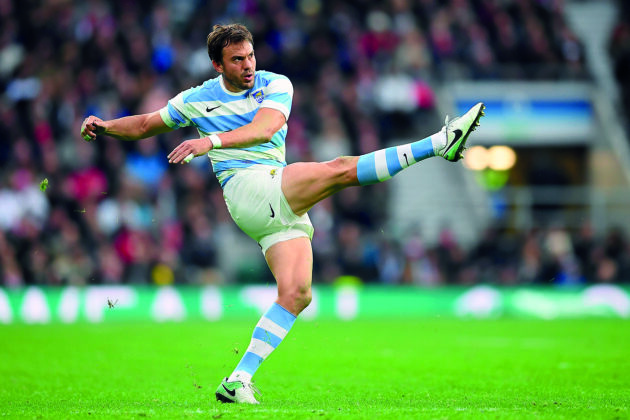
As a very hot, almost dangerous, summer in Buenos Aires fades into autumn, Juan Martín Hernández is wearing shorts.
He sits down with Rugby World at the San Isidro Golf Club restaurant, with the sun shining behind and the trees and rolling grass a perfect setting for a chat with one of Argentina’s greatest players.
At 42, he looks as fit as when he played. He smiles when told so but confirms that he wouldn’t be able to take a field.
“Not in today’s game.”
He carries no real aches or pains, which he attributes to the healthy lifestyle he embraced at home from a very early age – more on that later. He orders chicken and a salad, too healthy for many human beings.
A long scar on his left knee, and a few on his face, are testament to the sport in which he excelled, but not much more would give away how good he once was.
Juan Martin Hernandez has called time on a scintillating career as one of @unionargentina's very brightest stars.
Farewell 'El Mago' 👏 pic.twitter.com/eMcYDQdW8i
— World Rugby (@WorldRugby) April 10, 2018
He has had his share of injuries, as expected for someone who played at the highest echelon of the game for almost a decade and a half. Yet, he looks, and is, healthy.
“My worst injuries were two ACL operations; fortunately, my shoulders never got injured,” he starts, silently explaining why his defence was so robust.
The choice of venue for this meeting is his. A social golfer, he lives within walking distance of the club and probably a mile from a coffee shop he owns, one of many enterprises which keep him busy nowadays.
He remembers his first golfing day when he was a player with Stade Français a long time ago, from 2003 to 2009.
“We were in a training camp in Biarritz and Fabien Galthié, our coach, took us to a golf course. He was surprised that I’d never played before and I was so natural.
“Back then, whenever I had a day off, I’d rather go and kick a rugby ball than play golf.”
He seldom plays competitive golf, a sport that became his shelter after quitting rugby in 2018. Five years later, he was inducted into the World Rugby Hall of Fame.
“I like coming to the club when I have some spare time, maybe play a handful of holes. It helps me stay fit in a nice, quiet environment. It gives me time with my thoughts and challenges me. Having been so focused on high performance, it helps my headspace.”
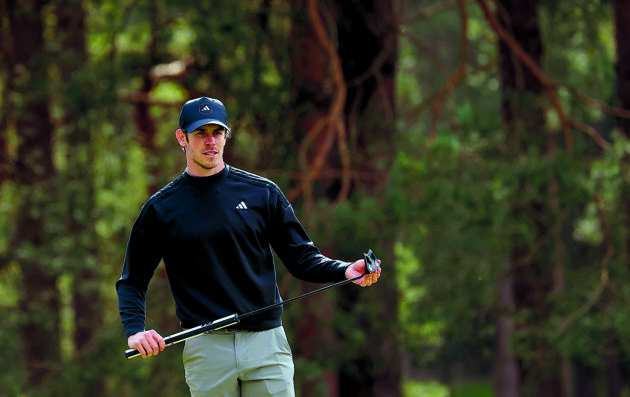
Gareth Bale putts on the 3rd green during the first round of the Sunningdale Foursomes (Photo by Warren Little/Getty Images)
Hernández became an R&A Ambassador recently – Gareth Bale is another sportsman in the same role – after golf’s realisation that they needed to open new markets.
“They wanted to come out of the perception of being an old and boring sport. Today there are more dynamic ways of playing golf.”
Taking on a golf professor after retiring from rugby, he fell in love with the sport. He might play on his own or with friends but he tries to play regularly, sometimes not keeping the score.
Read more: Why an away day in Vannes should be on your rugby bucket list
His handicap “of around 11” would be lower if he put the time to play in tournaments. Of his former team-mates, Gonzalo Tiesi is on 16, while Lucas González Amorosino and Felipe Contepomi, both kickers in their day, play under ten. His friends Horacio Agulla and Juan Manuel Leguizamón also play.
“I’ve been invited to Portrush for the British Open. It coincides with the Pumas playing the Lions, so hopefully I have to be in Dublin for that game and can combine both.”
Rugby has also been trying to become more relevant as a sport in a hectic entertainment market.
“They are working very well to protect players with the new rules, but there is still a lot of stoppage time and those who don’t really know the game struggle to understand. It’s not an easy game.”
If he was to describe his job, it would be ‘rugby analyst’, which he does for ESPN in every Pumas’ match. Usually by his side is Alejandro Coccia, who, like Bill McLaren, Keith Quinn, Pierre Salviac, Gordon Bray and Hugh Bladen, has become the voice of his country’s rugby.
Coccia was the first person to interview a young Juan Martín Hernández when he was coming through with the Pumitas, the U19 national team; now they sit side by side in Internationals.
“I saw him train and he was juggling with the rugby ball and that was surprising. He was already big and strong. I remember him as very respectful, humble and a very focused young man,” Coccia says.
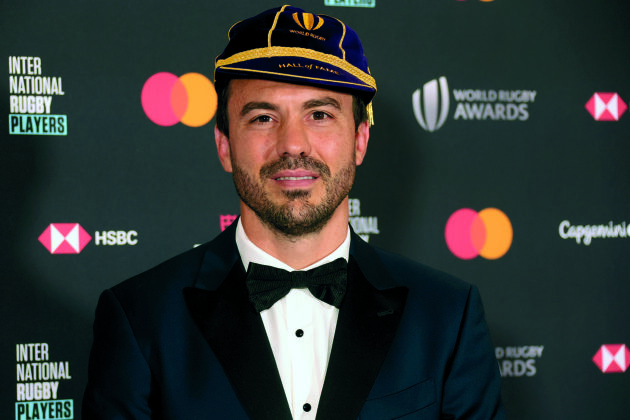
Hall of Fame Inductee Juan Martin Hernandez of Argentina poses following the World Rugby Awards 2023 (Photo by Jean Catuffe/Getty Images)
“He wasn’t a good place-kicker then but he was a standout player, understood the game, was a swift runner and a strong tackler. He was pure class.”
Class and Hernández are synonyms. Hernández’s late father Miguel was a fitness instructor and taught his household from an early age to look after their bodies.
His uncle Patricio played soccer for Argentina and was a team-mate of Diego Maradona’s in the 1982 FIFA World Cup. His cousins have played pro football and older sister Maripi is an Olympic medallist and a world champion hockey player, still playing in the first division at the age of 44.
When Patricio was coach of a First Division club, Hernández would accompany him to training and have a kick-about with his cousins. The club soon offered him a contract, which he declined. He was too young and wanted to play rugby for his club with his friends.
Spiritual Home
Deportiva Francesa is his rugby home. He has played for Stade Français, Toulon and Racing Metro in France, Natal Sharks in South Africa, and – the curtain call – Jaguares in Super Rugby.
He enjoyed each and every experience but there is only one home and that is ‘Depo’, as the club is dubbed. His father played there, his brother captained the first XV and from an early age Hernandez was the senior team’s ballboy, tee-boy, water-carrier, a bit of a menace growing up as he’d spend every weekend running around.
A try-scorer on his senior debut at 17, Hernández always returned to Deportiva Francesa. Today, he goes there two or three times a week.
Two of his sons play in the U16s and U8s, so he drives them to practices. He is a member of the rugby committee, sits on the club’s board, works with coaches and is available whenever needed, as well as attending senior games. They currently lie in the competitive second division in Buenos Aires.
“It is amateur rugby and I love it,” says Hernández, who was always on fat contracts and at big clubs, shining in the biggest of arenas.
“We try to give players that choose the game as a complement to their lives good values, a safe place. Their aim is to be better for the sake of being better at their chosen sport and we support that.
“Going to the club gives me energy. My mates are involved in leading the club and our culture is that at your club you always give.”
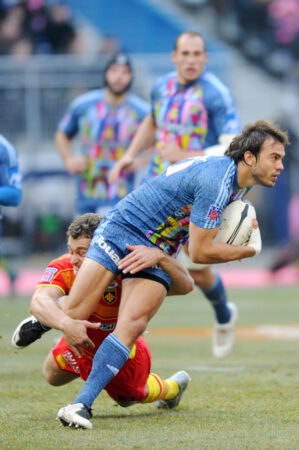
Paris’ Juan Martin Hernandez (R) is tackled by Perpignan’s centre Maxime Mermoz during the Top 14 (LIONEL BONAVENTURE/AFP via Getty Images)
Oldest son Beltrán, 15, is well aware of who his father is; the two youngest, Joaquín, ten, and Tomás, eight, got an idea during the 2023 World Cup when seeing how many people would say hi to him.
“I was on a giant billboard in Champs-Élysées with many former players and we also went to Stade Français where I am in many photographs.”
Heavily involved with his sons as they grow up, he knows that the surname could be a burden. Beltrán, by all accounts, has all the skills. He plays in the backs, has legs like pistons, kicks well and has a huge frame for the age.
“I can help him with his game and with his emotions, but I can’t help him handle who I am. He only started playing two years ago, his own decision. I talk about rugby with him when he asks and the game connects us.”
It’s likely not a rugby day goes by without someone mentioning his father to him.
“Comparisons are there all the time, it is something I would prefer wouldn’t happen. I hope he enjoys playing with his friends at the club, without the pressure of who his father is.”
Whilst Joaquín has chosen to play football, Tomás has only just started mini-rugby and loves it.
Almost a Tiger
In his youth, Leicester came calling and Hernández could have been a Tiger. He was told to enter the country as a tourist and his visa would be sorted out after that. A zealous immigration officer allowed him in but only for a week.
Tigers’ loss was Stade Français’ gain and he went on to play 123 games for the Parisian side, including winning the Bouclier de Brennus in 2004 and losing the then Heineken Cup final a year later.
A full-back used sparingly at fly-half, he was one of the team’s stars. After success at the 2007 World Cup, where he was surprisingly selected at ten, with the Contepomi twins outside him, he began dreaming of playing Super Rugby.
He moved to Durban but a back operation only allowed him nine Currie Cup games. The long road to recovery took him back to Paris, where he played 75 more games over three seasons across town for Racing Métro, finishing his French sojourn with Toulon.
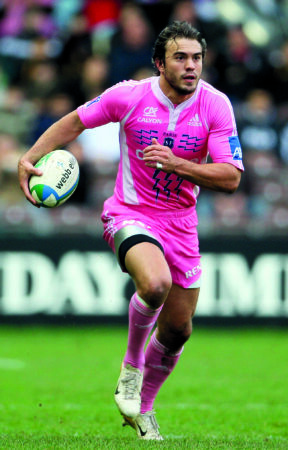
Juan Martin Hernandez of Stade Francais runs with the ball during the Heineken Cup pool 3 match between Harlequins and Stade Francais at the Twickenham Stoop (Photo by Phil Cole/Getty Images)
After his third World Cup in 2015, he returned home as a marquee player for Jaguares, the Super Rugby franchise based in Buenos Aires. His professionalism and experience was a godsend for the younger generations keen to learn from his; despite only playing 16 games in three seasons, he left a mark, as he did in all of Argentine rugby.
His 74 caps are testament to one of the greatest-ever Pumas. Since retiring, he has continued working with brands and sponsors, has a tech start-up with friend and partner Gonzalo Tiesi and has also embraced television punditry.
Read more: How to watch the 2025 Rugby Championship
“Being on TV was harder initially because the players I was commenting on were my friends or former team-mates. I have since found a way to talk on what I see on a rugby field, highlighting the good and mentioning mistakes. In doing this, I’ve had no problems.”
Coming from a team environment, television to him is quite similar.
“The environment is very good; most of us are friends and, at times, on the air it feels like a conversation with mates.
“I like to talk and analyse what happens on the field; I don’t get involved when the discussion is on who should play or not.”
Argentina’s 𝘌𝘭 𝘔𝘢𝘨𝘰
World Rugby Hall of Fame inductee No. 165, Juan Martín Hernández#WorldRugbyHOF pic.twitter.com/T03bvLzScW
— World Rugby (@WorldRugby) October 11, 2023
Coccia adds: “As much as I enjoyed him as a player, I have to admit I also enjoy him as an analyst. He is very generous, speaks his mind, is open to debate, humble and consistent.”
Hernández has loved the game from an early age and always had a well-trained eye on its nuances. He is in a prime position to analyse the game.
“I like these Pumas. Under Felipe (Contepomi), in 2024 they showed some of the rugby that (previous coaches) Mario (Ledesma) and Michael Cheika would have wanted for the team. There is a great balance between attack and defence and there has been an evolution of what they are trying to achieve, which is why we saw their best version last season.
“Argentina plays a fluid game, with a team filling the width of the field, where every player has a role without the need to be in the starring role. When you are a fit team and understand where, when and what you want to do, you have the luxury of time.”
As a player who would have loved to play all his career at No 10 but was good enough to play at centre and full-back, Hernández can comment on a debate that has kept Argentina busy for the past couple of years: where should Bath-bound Santiago Carreras play?
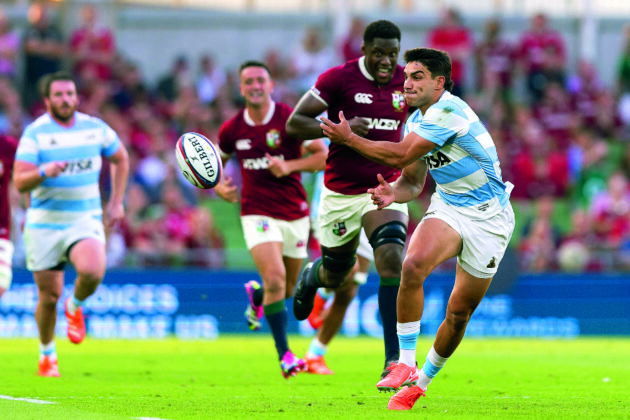
Santiago Carreras of Argentina passes the ball during the 1888 Cup international match between British & Irish Lions and Argentina at Aviva Stadium (Photo by Gaspafotos/MB Media/Getty Images)
A question that not every Gloucester fan has been able to answer.
“He’s good at 15, he’s good at ten. With Cheika’s game-plan he was more of a fly-half; today, numbers on the shirt are not important. Take the game against Australia when Argentina won 67-27; you had Juan Cruz Mallía, Tomás Albornoz and Carreras, all good playmakers who can play the ball.”
With his physical presence and silky skills, he would have certainly shone in today’s rugby.
“I would have loved to play today. With Stade Français we moved a lot of the ball because of the players we had. And you can see with Fabien (Galthié), that is what France is trying to do.”
He says the French coach was the best he played under.
“Great, great coach. I was only 21, yet still he spoke to me a lot about rugby and would also listen; as a player being listened to is empowering.
“Today he is not as hands-on as he was. It has given him balance with a team that has many quality players, physical presence, intensity and can play non-stop rugby. I see no negatives with them.”
“What a pleasure it would have been. Excellent players make you play better. He’s the best and he only needs to win the World Cup to stamp it. In the way France plays, he could play in any position. He has elevated the way rugby is played.”
Whilst he only commentates on Pumas’ Tests, he enjoys watching the Six Nations, the Premiership and the URC. He likes what England and France did this year.
“English teams have very clear concepts, are clinical and hard. You see this in the Premiership and then when England play internationally.”
Asked about European tens, he says: “Sam Prendergast is a skilful player who makes good decisions. I like the new English fly-half, Fin Smith, and you can see that Gregor Townsend has given Finn Russell a framework to work from.”
So speaks the master, a player who made rugby look effortless.
Download the digital edition of Rugby World straight to your tablet or subscribe to the print edition to get the magazine delivered to your door.