



Can Ireland's injury crisis be a blessing in disguise for Andy Farrell in the 2026 Six Nations championship? Paul Williams argues the case...
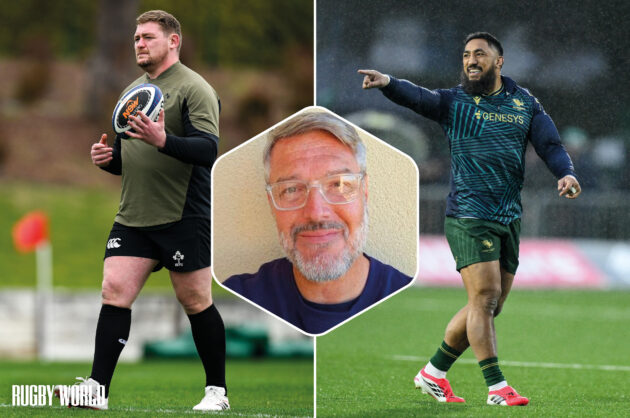
Before we start, and various health professionals bombard the comments, no injury has ever benefitted any player – ever. As sayings go, “that which does not kill us makes us stronger”, by Friedrich Nietzsche, is arguably the one of the most stupid of all time.
Try asking a prop who’s torn their calf muscles/ snapped their Achilles, if they were stronger after the incident? The answer is no. Once a prop has had that sort of injury in the lower limbs, they tend to create more injured calves than a negligent dairy farmer.
However, with that said, injuries in the short term for Ireland, could benefit their squad long term.
Injuries to the 2026 Six Nations’ squads aren’t only an issue for Ireland of course. All of the nations have injuries to varying degrees – that’s just how rugby is.
Read more: Here is Ireland’s team to take on France in the Six Nations opener
England have got stacks of front row personnel missing with Will Stuart, Asher Opoku-Fordjour, and Fin Baxter all injured to varying degrees – for Stuart and Baxter the dairy farmer reference above has never rung truer.
Scotland have issues with Dave Cherry, Jamie Dobie, Liam McConnell and potentially Jack Demspey.
Wales are of course without the irreplaceable Jac Morgan and so too arguably their most improved player – Keiron Assiratti. As an aside, outside of player injuries, Welsh rugby is also currently creating some deep, deep tears – that could take way longer to heal than any flesh wound.
Ireland’s injury crisis
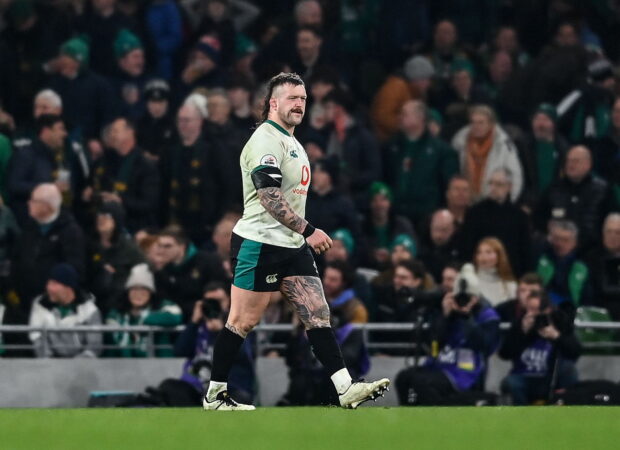
Andrew Porter is absent for Ireland through injury. (Photo By David Fitzgerald/Sportsfile via Getty Images)
But for all of England’s injury issues up front, it’s Ireland who are currently getting the injury headlines. There are two reasons for this. Firstly, Ireland’s injury list is long.
This past few weeks in Irish rugby has been like the opening scenes in Saving Private Ryan. Even as this column is being written/ published, another Irish test player is probably rolling their ankle.
But the second reason that Ireland’s injuries are getting so much traction is that it shows just how slow that squad has been to evolve during this Rugby World Cup cycle.
Ireland have injuries across their squad, but it’s at tighthead, and especially loosehead, where the issues are most severe.
Related: How to watch every Six Nations game for anywhere in the world…
As with most test teams, it’s where they require players at their heaviest that they are at their thinnest. Ireland have long relied on the generational skillsets of Tadhg Furlong and Andrew Porter. Without either available Ireland look vulnerable upfront and that has been the case for the past 18 months.
This issue is particularly cruel for Ireland, because despite being behind two years behind other major test teams in some areas of their squad rebuild, at loosehead in particular, they do have young options ready to roll. In both Paddy McCarthy and Jack Boyle they have test ready looseheads who are ‘plug and play’ options for test rugby.
Central issues
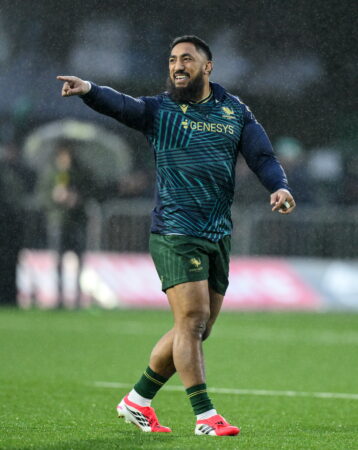
Bundee Aki will miss the first three games of the Six Nations after a ban. (Photo By Brendan Moran/Sportsfile via Getty Images)
But whilst Ireland have over recent seasons had at least blooded some good loosehead props, it’s at centre, where the selections really seem to have been frozen in time. And as a result where the current injury and suspensions have hit hardest.
Robbie Henshaw is injured, and Bundee Aki has been banned for four-games ban due to “verbal abuse and disrespect” towards match officials.
We could spend the next five minutes discussing why Aki had a weird freak out and starting abusing officials, but the time would be better spent reasoning why Ireland are still relying almost entirely on a midfield over the age of 30.
Bundee Aki, Robbie Henshaw and Garry Ringrose are still the mainstay of the Irish midfield, with all three being over 30 years of age – Aki is 35.
Related: How Dan Sheehan became Andy Farrell’s main man for Ireland
Most teams in the world’s top three, with the recent dominance that Ireland have had, should have been looking at blooding new centres – but for some reason they chose not to.
Ireland have some fantastic options available to them – especially in the centre. Anyone who’s seen Jude Postlethwaite play for Ulster and doesn’t think he’s ready for test rugby, needs to watch more of Jude Postlethwaite. The same goes for Cathal Forde at Connacht – he’s got the lot.
It would be unfair to suggest that Ireland haven’t selected younger options in some positions – they have. The selection of the incredible Tommy O’Brien on the wing, is an example of Ireland selecting some younger options, but even O’Brien isn’t exactly young.
He’s 27 now, with a handful of caps, having been first selected at 25 years of age. O’Brien is only two years younger than Hugo Keenan for instance.
Is age an issue for Ireland?
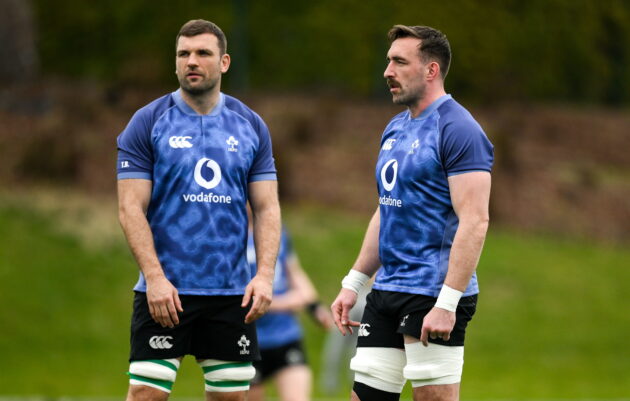
Tadhg Beirne and Jack Conan are both into their thirties. (Photo By Brendan Moran/Sportsfile via Getty Images)
It’s almost as if the Irish selection focus was solely based on picking two very young (and impressive) outside halves in the Sam Prendergast/Jack Crowley, and then assuming that it would drop the average age of the squad so much that no-one would notice how old everyone else had got.
None of the above is of course designed to say that all players over the age of 30 can no longer function in test rugby.
That isn’t the case at all, especially in the tight five. Just look at Tadhg Beirne for example, who at 34 is still hugely dominant in every aspect of the game. He still hits like a car and cleans up like a car vacuum.
Then there’s Jack Conan, who at 33 is still arguably one of the most consistent players that the game has ever seen. He may rarely deliver 10/10 player ratings like Ardie Savea etc., but equally he never drops below an 7.5/10 – in any game he’s ever played.
Read more: All you need to know about the 2026 Six Nations championship
In total, through injury, or unnecessary words to officials, Ireland will largely be without Bundee Aki, Robbie Henshaw, Ryan Baird, Paddy McCarthy, Andrew Porter, Mack Hansen, Hugo Keynan, Jack Boyle and potentially Tadhg Furlong. That’s a big list.
But whilst we’re talking about Six Nation’s injury lists, which are largely inconsequential in wider society, lets spare a thought for Uini Atonio.
Who has recently had a heart attack in training and has been forced to retire. The French tighthead was immovable and the massive frame on which La Rochelle and French test rugby hung off.
Heart attacks, put broken thumbs and tweaked calf muscles into perspective. Get well soon, Mr. Atonio.
Download the digital edition of Rugby World straight to your tablet or subscribe to the print edition to get the magazine delivered to your door.