




France’s Class of 2023 won the U20 World Cup at a canter. Now they are making the Men’s Six Nations look easy…
Cast your mind back to 2003. A World Cup down under, Jonny Wilkinson’s right boot and English rugby’s greatest hour.
Across the Channel, French fans were licking their wounds at the semi-final loss in the Sydney rain, Fabien Galthié’s final appearance for his country. Little did they know that the year of one of their biggest Rugby World Cup disappointments may end up being the starting point for their bid for a first Webb Ellis Cup when the tournament returns to Australia in 2027.
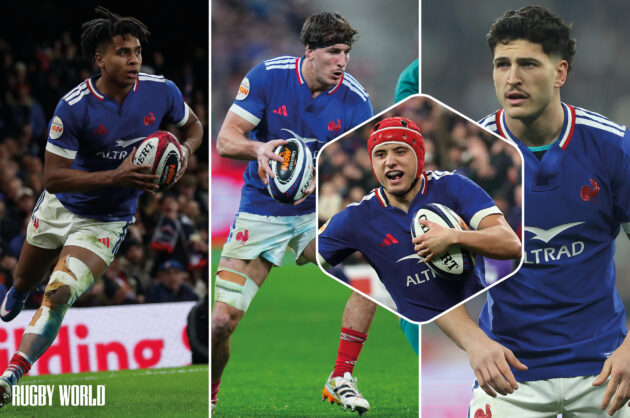
For all the talk of RWC 2023 on home soil being France’s perfect chance to shake their tag as the best team never to win the World Cup, there is a new generation ready to pick up the baton in 2027. The class of 2023 are already making their presence felt on the Test scene, two-and-a-half years on from one of the most emphatic U20 World Cup titles of all time.
In South Africa in 2023, France swept past all before them to win a third successive global title at U20 level. They won every game by at least 21 points and did so without their biggest stars, Louis Bielle-Biarrey and Émilien Gailleton, both of whom were busy training with the senior team.
A 52-31 semi-final win over England was followed by a 50-14 rout of Ireland in the final, with eight of the starters from that clash now full internationals, to go with Bielle-Biarrey and Gailleton.
With the 2026 Six Nations now underway, the likes of Nicolas Depoortère, Oscar Jégou, Lenni Nouchi, Théo Attissogbe and Hugo Auradou are now fixtures in the squad. Others, like Posolo Tuilagi and Marko Gazzotti, all excelled in that tournament while still U19s and they haven’t looked back since.
Premium players
For Sébastien Calvet, who coached the side and is now back working with the FFR after a spell at Agen, it was a 35-14 pool win over New Zealand that made him realise just how special the group could be.
“You can tell quite quickly if you have players that we might call ‘premium’,” he explains. “Often when you have an age-group side, you think, ‘I’ve got some premium players in this position but not there’. But when it came to 2023, as the competition went on, we realised we were pretty complete at every level, at pretty much every position.
“We didn’t have Louis Bielle-Biarrey and Émilien Gailleton with us, so we thought the potential of the team had been diminished a little, particularly in the back line.
“But the big surprise was the pool match against New Zealand in the mud, where the team pulled out an exceptional performance. The rugby output in those conditions, and given the quality of the opponent, made us sit up and take notice. We went from an evaluation where we knew we had some talent to realising that we could really compete in this tournament.”
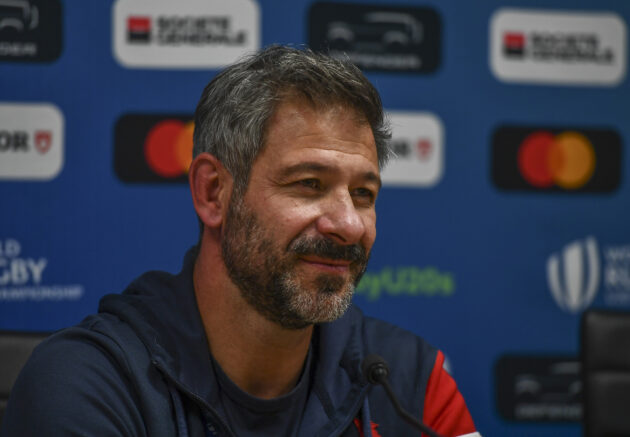
Sebastian Calvet blooded numerous stars of the future when he coached France’s 2023 U20 World Championship-winning side (World Rugby/World Rugby via Getty Images)
They did more than just compete and by the time France head to Australia in 2027, it’s conceivable that a third of the squad could come from the 2023 U20 champions.
Part of their development stems from how France have used their summer tours, often resting their top players and building depth. But just as crucial has been the faith shown by coaches in the Top 14 in budding players.
Faith in youth
Bielle-Biarrey was just 18 when he made his debut for Bordeaux-Bègles, starting as he meant to go on with a hat-trick against the Scarlets. Gailleton was similarly precocious, with Agen and then Pau, the latter coached by Sébastien Piqueronies, who led France to U20 titles in 2018 and 2019.
Piqueronies has since turned Pau into an emerging force off the back of some of the best young talent in the country, with the likes of Joe Simmonds and Dan Robson often lining up in teams featuring an entire three-quarter line of backs aged 22 or under. Even more importantly, lock Hugo Auradou was immediately trusted with the lineout calling at Pau, while scrum-half Baptiste Jauneau was named Clermont Auvergne captain while only 20. That approach has been vital to their development in Calvet’s eyes.
“My biggest surprise has been the decision of club coaches, and Fabien as well, to throw these players into the big time so quickly,” he says. “A few years back, a player like Hugo Auradou, who is a lineout specialist and among the very best but perhaps not as heavy as some of the other second-rows, coaches would have waited quite a bit longer, even though he had done really well at the World Cup.
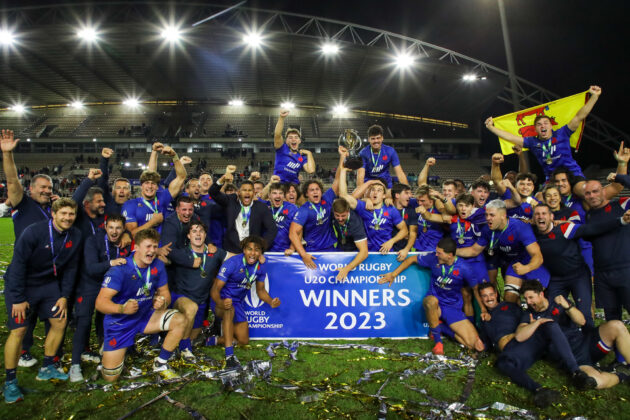
The 2023 U20 World Championship-winning team has proved to be an impressive factory for top-level internationals (World Rugby/World Rugby via Getty Images)
“I am not surprised by how the players have performed because I’ve been involved in the federation for a long time. But before, we’d see the players, we would identify them, then lose sight of them for a few years and then in five or six years they would re-emerge.
“We knew these guys would come through, when you see Nouchi, Jégou etc. But the nice surprise is the trust shown by the coaches.”
For those who have impressed on summer tours, chances have then been forthcoming with the full side. Jégou was crucial to France’s Six Nations title run last year, his ability to cover the back row and centre proving a bedrock of their 7-1 bench tactic. Versatility is all in a World Cup squad.
In addition to Jégou’s centre credentials, Toulon back Mathis Ferté, who scored two tries in the 2023 U20 final, could come into contention with his ability to cover scrum-half, full-back and wing.
Read more: Who is Louis Bielle-Biarrey: Learn more about France’s star winger
Star quality
The jewels in the crown, though, are Bielle-Biarrey, Gailleton and Depoortère, with the first two having played two years up for the U20s, and the latter arguably France’s top performer at the U20 World Cup.
Calvet says: “Louis and Émilien were in the U20s at 18 years old. There was a try they scored against Ireland in the 2022 Summer Series, when those two and Nico Depoortère all touched the ball.
“Louis’s speed was obvious but he also had the advantage of having started out at fly-half. Émilien was the king of the GPS – he had scores on the GPS that were superhuman. And then Nico was the rage and efficiency in contact, with pace too.
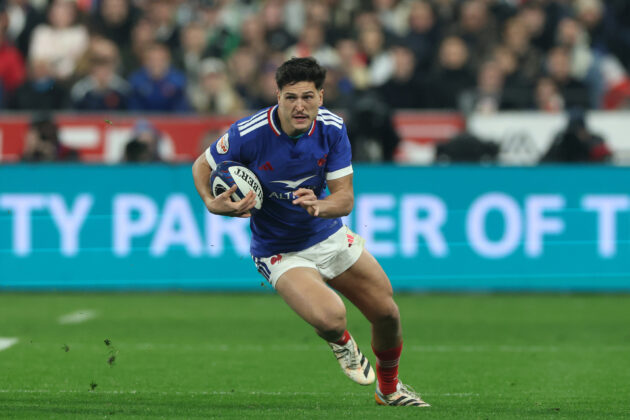
Nicolas Depoortere was “the rage and efficiency in contact, with pace too” (David Rogers/Getty Images)
“Every time you came across starlets like that, Didier Retière (former technical director at the FFR) would talk about superpowers, there are things that stand out. Everybody can see it. For Émilien, it was a bit trickier, you needed to look closer. You might not think he had done too much on first viewing and then when you go back over it, you see that he has put in a huge amount of work for the team.”
The question now is how many of the class of 2003 can reach the heights of Bielle-Biarrey and his World Player of the Year nomination and 23 tries in 24 Tests. Certainly, they are not short of admirers within the senior coaching set-up, including the man charged with managing France’s defence.
Reflecting on the next generation coming through, Shaun Edwards says: “Put it this way, if I had to pay to get in, I’d pay to watch these guys!”
November blues
As they aim to make it back-to-back Six Nations titles for the first time in nearly two decades, France have welcomed back key contributors who were absent in the autumn such as François Cros, Peato Mauvaka and Yoram Moefana. Oh, and a certain Antoine Dupont, who was missed as France lost to South Africa and beat Fiji and Australia none too convincingly.
For Edwards, an under-par November might not be the worst thing for the team with a view to the World Cup:
“For the first game against South Africa, we hadn’t played together for eight months. We had about 10 days together before the game. I thought the performance was pretty strong until the last 10 minutes.
“Sometimes it’s no bad thing not to be too fantastic in the autumn. You have that bit of critique where you know what you need to work on. I think it’s good for us, having been champions last year, it’s good sometimes to have a little jolt.”
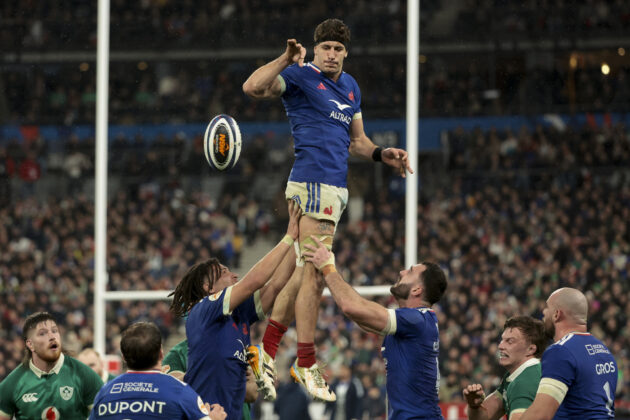
The versatility that allows Oscar Jégou to play both back row or in the centres could be invaluable during a World Cup (Jean Catuffe/Getty Images)
A case for the defence
In 2025, France’s Six Nations success was founded on a remarkable attack, setting a record for tries scored in a championship with 30, including eight for Bielle-Biarrey. This time, there’s set to be a greater focus on defence, even if Edwards is at peace with the fact that his old defensive targets have had to be adjusted.
“The landscape is totally different,” he explains. “I coached a team [Wales] in 2008 that conceded two tries in the whole Six Nations. That is impossible now.
“It has changed for two reasons: one, the rules, and quite rightly. World Rugby wants more points because people want to see tries. But also the state of the pitches.
“Our target used to be 13 points when I was with Wales. Then that moved up to 18. Now the target is 22-23. If you can get under 20 points, you’ve had a magnificent day. For the Six Nations, we’re going to have a lot more emphasis on the defence, so I’m happy!”
In 2023, France’s attack carried them to global U20 glory. Now those players are being drilled on the other side of the ball by one of the game’s most decorated defence coaches.
As the Webb Ellis Cup returns to Australia, France’s best hope of lifting it may come from a group of players who were still in nappies the last time the world’s best converged down under.
Download the digital edition of Rugby World straight to your tablet or subscribe to the print edition to get the magazine delivered to your door.