





Rugby World took a trip to Cardiff to see if the rumours about Wales being the best Six Nations gameday are true…

If rugby had a heart, it would beat Welsh. And while I’m not sure whether that actually means anything, what I do know is that rugby is the life and soul of the nation of Wales. While other nations may like rugby or be very good at it, few actually revolve around it.
Speak to Welshmen and women about why this country has such a bond with the sport and most will fail to put their finger on a specific reason but just know that when you are born, rugby is in your bones. Ultimately, the sport of rugby union is deeply engrained in Welsh society, with some even describing it as helping to sculpt Welsh nationhood in the 20th century because of what it represents.
Read more: Why is the roof at the Principality closed?
Whereas other nations have seen rugby as the sport for publicly educated schoolboys with wealthy parents, rugby has always been a sport for the average working person in Wales. An opportunity for small-town boys from modest circumstances to represent their nation on a global stage and be considered one of the best in the world.
You could be a miner’s son from Merthyr Tydfil or a farmer’s lad from Ammanford, if you’re good enough, you can play in the red of your country for Wales. And for the best part of 125 years, this meritocratic team has been reflected with support from every nook and cranny of Welsh society, from the city streets of Swansea to the rolling hills of the Brecon Beacons.
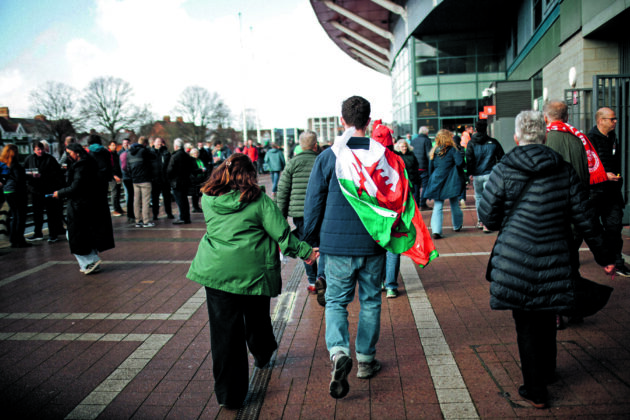
Fans gather at the Principality Stadium (Dom Thomas)
Even in these recent darker times, mums, sons, daughters and dads in their thousands will continue to turn out in the terraces and stands with their red-and-white scarves and daffodil masks to support this team that is part of their life. And it is this what makes a Six Nations showdown in Cardiff at the Principality Stadium to watch Wales a rugby experience you need to do before you die.
While a day trip to Cardiff from London is possible, I decided to treat myself to a Friday night in an easyHotel before today’s game, a daunting Six Nations battle with defending champions Ireland. I wanted to be in the city on match day as early as possible to see if this atmosphere that is so talked up was genuine.
Read more: Wales Six Nations squad
Prior to travel, I’d heard rumours of accommodation daylight robbery during championship weekends, with most hotels cashing in on the increased footfall with highly-inflated prices. But I think I have found myself a good deal. My room was only £80 for the night, was so small it would have been physically impossible to lose anything in there and had an unbeatable view of HMP Cardiff. Crucially, too, it is slap-bang in the middle of the city.
Going for a morning trot before the game, I cover 5km and in doing so encompass the stadium, its neighbouring Arms Park, the River Taff, Bute Park, the castle, the entire city centre that has already been shut to traffic ahead of the day’s game and a gaggle of Irish fans in leprechaun outfits searching high and low for a cooked breakfast and a pint. That’s the beauty of coming to a Six Nations game in Wales, you see.
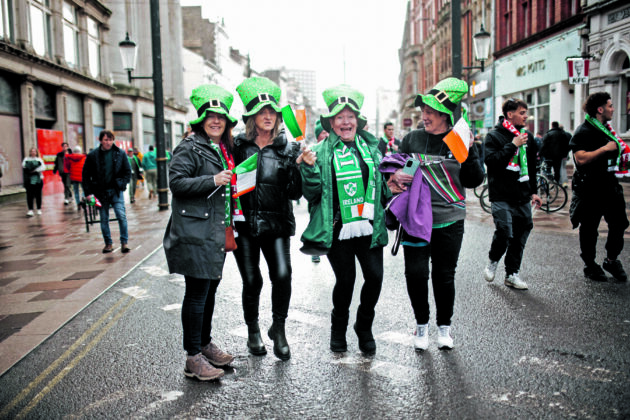
Irish fans get ready for the game (Dom Thomas)
This isn’t like Twickenham or Murrayfield where you’re dispatched to the outer reaches of suburbia for your rugby via unreliable commuter train services. The Principality Stadium is the celestial mass around which Cardiff orbits. And being modest in size, the 75,000 or so rugby fans who descend on it for a match day, like water, get everywhere.
Leaving my digs, I enter the first pub I stumble upon, the flat-roofed Traders Tavern, voted the best independent pub in Cardiff by constituents of the city centre, according to the banner draped across its front. At 10am it’s already full of red and green shirts enjoying pints of Guinness for £5.50 and reasonably-priced shot deals.
Wading further into the city, it gets ever busier. The main pedestrianised thoroughfare, Queen Street, is full of fans of all ages slowly making their way towards the stadium too, stopping en route for a Greggs or McDonald’s. I also negotiate a dozen or so stands selling Welsh paraphernalia for the game. By the fifth, I crumble and buy myself a daffodil headpiece but draw the line at the dragon facepaint.
Eventually I pop out on Quay Street and the City Arms pub, a recommended spot in a shadow’s grasp of the ground. Comedian Mike Bubbins told me recently that Brains beer is to Cardiff what Guinness is to Dublin and that whenever I visit the city next, I’m not to drink anything but the local drop. With that, I get myself a pint of Brains SA 4.3% ale and a ham roll that has been wrapped so tightly in clingfilm it could survive an apocalypse. It’s refreshing and sessionable. I give it the Rugby World stamp of approval.
Cardiff’s rugby soundtrack
They reckon in London that you’re never more than 6ft away from a rat. Well, in Cardiff you’re never more than 6ft away from a male vocal choir. Outside the City Arms are not one but two choirs in shirt and tie. I get talking to a son-father-grandfather trio who are part of the a local group in town to sing the anthem pre-game. Before doing so they, along with their vocal counterparts, give me and the other pub-goers a rendition of The Fields of Athenry in homage to today’s visitors. Around me, others join in with the chorus, doing little to quash the cliché that all Welsh people can sing.
Standing outside the pub, I’m struck by something else. At other Six Nations games, a fairly narrow net could be cast over the clientele in attendance. Here, all walks of Welsh life seem to be present. You realise that old and young, city and country, wealthy and working class are present and correct.
There are multi-generation families where grandparents old enough to have watched Sir Gareth Edwards in the flesh walk hand-in-hand with children who only know Warren Gatland as the guy who led Wales to 14 defeats in a row. Groups of women in old, cotton home shirts paired with high heels for their night out in Revolution after the game chat to blokes who have chipped in for a minibus to bring them down from the Valleys. All different but all here for the same reason.
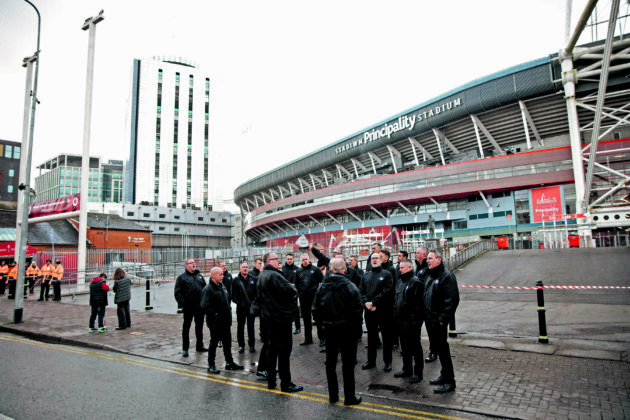
Choirs ready the fans for the game (Dom Thomas)
Welsh rugby is engrained in the nation’s fibre and is representative of all its people and so it’s all of its people that make the pilgrimage to this stadium. After the pub, I wander into the ground, through its narrow walkways and out to my seat, directly opposite the tunnel. The closed roof on the stadium makes it look smaller than it is and makes for an almost claustrophobic feel. As the stadium begins to fill, the stands resemble a roulette wheel of colour as fans in the red of Wales and green in Ireland sit in blocks across the three tiers.
The choirs from earlier are already on the pitch and rattling through the hits, including the rousing patriotic ballad Yma o Hyd. With every song, more fans take their seats and more fans join in song. The sound lifts as we get to kick-off. When the two teams eventually rear their heads from the tunnel, the atmosphere is at fever pitch, with the anthem pushing us over the brink.
I think everyone should experience Hen Wlad Fy Nhadau (‘Land of Our Fathers’) sung live at the Principality Stadium at least once. Anthems in rugby, especially in the Six Nations, are a powerful thing and as someone who is less than enamoured with their own anthem, God Save the King, I’ve always felt envious of our rivals, particularly Wales.
Their anthem is hymn-like and builds in a way that would inspire the most passive into battle. Hear it roared with the unbridled passion of 70,000-plus Welshmen and women inside a closed-roof stadium, in unison with male vocal choirs, a brass band and a goat, and it will move you. Like experiencing divine inspiration from the pews of a rugby cathedral. While not brought to tears, my first experience of Hen Wlad Fy Nhadau is an overwhelming one. This is what live sport is all about.
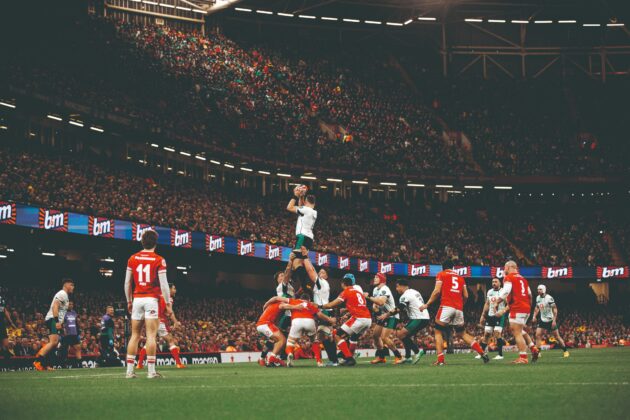
Wales and Ireland contest a line-out (Dom Thomas)
What helped today’s rendition was that it was also the first of the year in Cardiff, due to this being Wales’ first home game of the championship. It was also the first anthem post-Gatland. The once-beloved Kiwi had decided 14 consecutive defeats was the point in which he should part ways with the nation he’d been adopted by for the best part of two decades. His replacement, Cardiff’s Matt Sherratt, has popped in from next door to take over the reins on a temporary basis and brought with him a popular selection trio of Gareth Anscombe, Max Llewellyn and Jarrod Evans.
Wales daring to dream
It was a move that was enough to reinvigorate the belief of this nation and make them begin to dream. Maybe, just maybe, they could beat Ireland, the second-best team in the world, and end the streak. Then, with 40 minutes on the clock, when talismanic captain Jac Morgan was bundled over the line to put Wales into a shock lead at half-time, the stadium took off into orbit. A roar that could have been heard across the border it was so loud; a sound of Welsh people expelling 18 months of pain as they realised that light may be at the end of this long, dark tunnel.
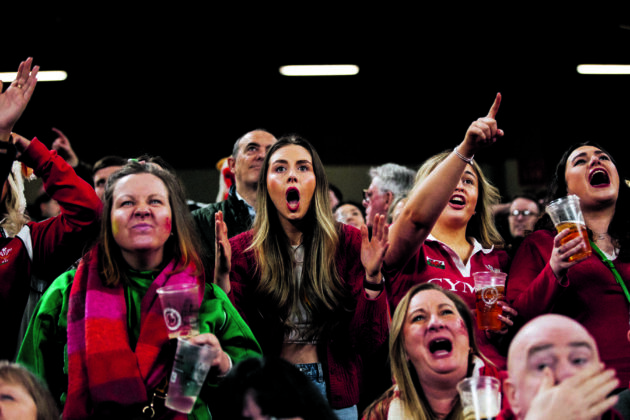
Fans watch on at the Principality (Dom Thomas)
This was not the script we had been shown in the readthrough. Wales are not meant to be leading at half-time. But with Garry Ringrose serving a 20-minute red card and Sherratt’s liberated playing style being managed perfectly by Anscombe, the script had been ripped up and dunked in a pint of Guinness. And if I thought the atmosphere was palpable with Morgan’s try, when flying Tom Rogers produced an acrobatic dive into the bottom corner to extend the lead after the interval, everything turned to 11.
Ultimately, the ballast of Bundee Aki and surgical precision of Jamison Gibson-Park at scrum-half were enough of a shovel to dig Ireland out of a hole on the Principality turf and keep the streak of losses going for Wales. Although, through the course of 80 minutes, even when the realisation that victory was a step too far, you could almost see the collective belief of the Welsh rugby public return.
It was a heroic performance. Tighthead prop WillGriff John went from laughing stock to prime Carl Hayman, outscrummaging supposed Lions starter Andrew Porter. Taulupe Faletau rolled back the years at eight. Winger Ellis Mee looked like a seasoned veteran of the international stage, not a 21-year-old who was playing semi-pro rugby a year ago. Yes, Ireland won, but they should have. They are the second-best side in the world. This was a fight between a heavyweight and a featherweight where the featherweight had the heavyweight on the ropes for most of the contest. And in doing so, the lifeblood of one of rugby’s most revered homes began to flow again.
After leaving the stadium and negotiating the Crystal Maze-esque route of complication back to the train station, managing to secure a Bounty and packet of flame-grilled steak McCoy’s for the two-hour journey back home, I watch as home fans disappear into the early Cardiff evening with smiles on their faces, standing a few inches taller than they had earlier that day. The home fans believed again. Welsh rugby is back.
Download the digital edition of Rugby World straight to your tablet or subscribe to the print edition to get the magazine delivered to your door.